Closing the gaps for survivors in Kenora
When a survivor in Kenora reaches out for help, the goal is simple: the right support, from the right people, without delay. That means services that communicate, organisations that share information, and a system where no one has to carry the weight of coordination alone: not the survivor, and not the frontline worker supporting them.
What makes that hard isn't a lack of dedication, it's the distance between systems that weren't built to connect. On May 20, organisations across the Kenora District are coming together to change that.
A three-year commitment to coordination
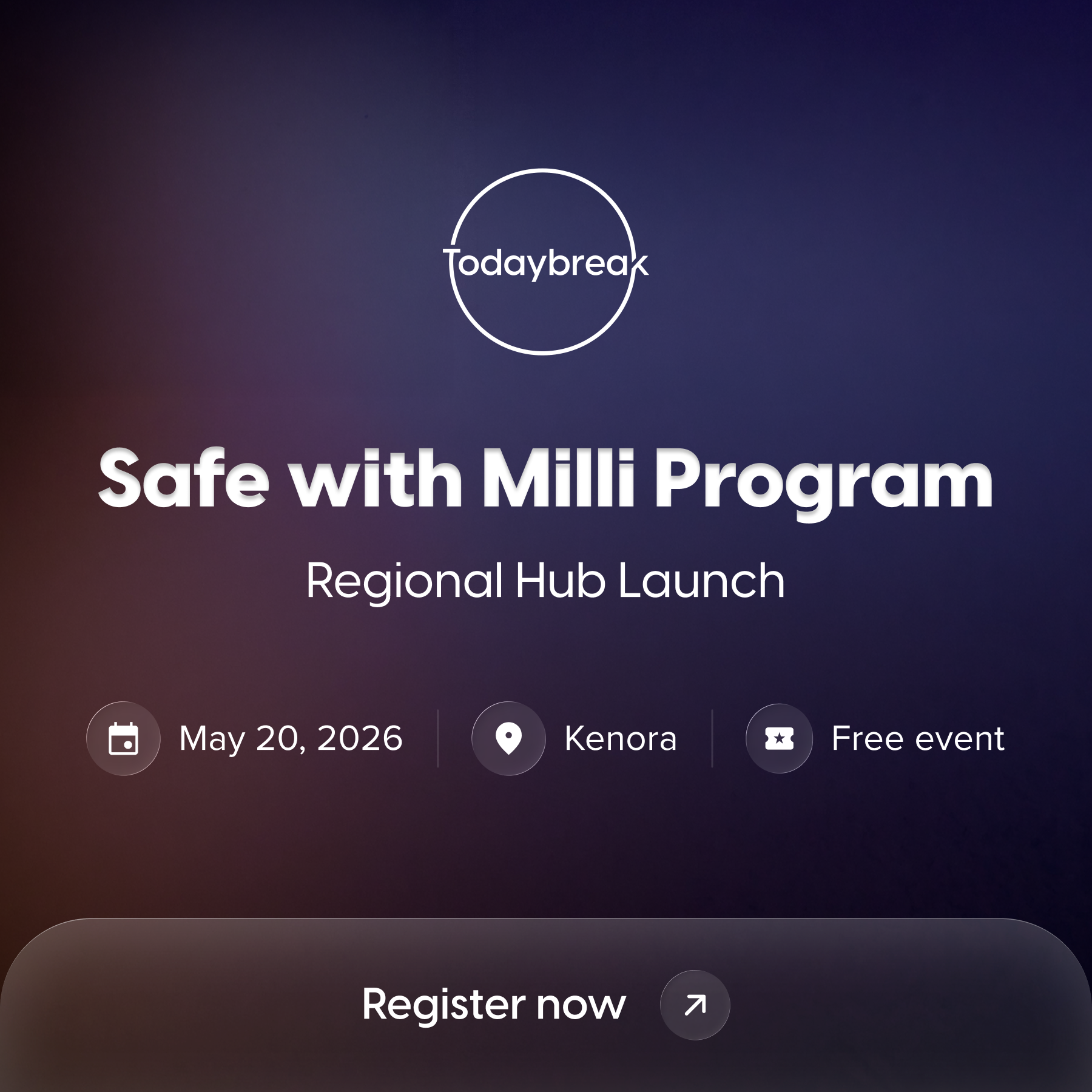
On May 20, Todaybreak is launching the Safe with Milli Program Regional Hub in Kenora, bringing frontline service providers, police, health, and government agencies together around achieving stronger collaboration, better information sharing, and more coordinated service delivery across the district.
In regions like Kenora, the geographic expanse makes coordination genuinely difficult. Co-locating services isn't a realistic answer here. The point of the Safe with Milli Program is to connect services across distance, so survivors don't pay the price for the space between them.
The Hub is supported locally by Victim Services of Kenora and the Treaty Three Police Service. It's a three-year commitment, with Todaybreak, Genvis, and Evolution Mining, a premier gold company who is proud to support the Safe with Milli Program in the communities where they operate, including those neighbouring their Red Lake Operations in Ontario. It’s not a pilot or a one-off event, it’s a sustained, accountable structure for how services in the Kenora area can work together.
The Safe with Milli Program already connects more than 40 frontline services across Canada and Australia. It improves service coordination, data sharing, and collaboration between the teams supporting survivors every day. Todaybreak partners with Genvis on the Safe with Milli Program, using their Milli personal safety app and Cudo case management platform. These tools support Community Hubs across Ontario, Manitoba, and British Columbia. Kenora is the next step, and it reflects what we’ve learned about where the deepest gaps are.
The problem that the hub will solve
When a survivor reaches out for help, the danger they're escaping rarely fits neatly into one service's mandate. The harm might have started at home, involved police contact, required housing support or child protection, and demanded ongoing safety planning - sometimes all at once, and often in the middle of a crisis.
The services built to respond to that harm were designed at different times, for different purposes, and funded through different streams. That's not a failure of the organisations involved, it reflects decades of policy built in silos, where a coordinated response was never the starting assumption. The result is that when a survivor needs multiple services at once, the work of connecting them often falls to the person least positioned to carry it: the survivor themselves.
Technology can help. But only if it's built around the people doing the work, not layered on top of systems that don't talk to each other. That's what the Milli app and the Cudo platform are designed to do: not to replace the relationships between organisations, but give those relationships the infrastructure they need to move at the speed a survivor in crisis needs.
Building a coordinated regional response in the Kenora District
Kenora sits in Treaty Three territory, and the launch event leads with that fact front and centre. The cross-sector panel "Building a Coordinated Regional Response in the Kenora District" features Sandra DeLaronde, Executive Director of Giganawenimaanaanig, who will open the discussion with remarks on the Red Dress Alert pilot preparing for launch in neighbouring Manitoba.
The Red Dress Alert pilot was called for in direct response to the crisis of missing and murdered Indigenous women, girls, and 2SLGBTQQIA+ people, also prevalent in Northwestern Ontario. Survivor-centred service delivery here starts with that acknowledgement.
Panelists will dig into how organizations can work together more effectively to support people experiencing violence and crisis. They will share practical perspectives on coordination, information sharing, and service delivery in rural and remote communities.
Join the launch
If your organisation supports survivors in the Kenora District, this is how we deepen that work together. Todaybreak is calling on frontline leaders, decision-makers, and practitioners across all sectors to participate.
The event runs from 10:00 AM - 2:15 PM CDT at the Perch Bay Resort, Kenora. You'll hear from local organisations already leading this work, see live demos of the Milli app and Cudo software, and learn how your organisation can participate in the Hub going forward.
Lunch and light refreshments are provided. Registration is free.